Smart pixel sensor filtering with deep learning
Aug 1, 2024·
,,,,,,,,,,,,,, ,,,,,,·
1 min read
,,,,,,·
1 min read
Jieun Yoo
Jennet Dickinson
Morris Swartz
Giuseppe Di Guglielmo
Alice Bean
Douglas Berry
Manuel. B. Valentin
Karri Dipetrillo
Farah Fahim
Lindsey Gray
James Hirschauer
Shruti R. Kulkarni
Ron Lipton
Petar Maksimovic
Corrinne Mills
Mark Neubauer
Benjamin Parpillon
Gauri Pradhan
Chinar Syal
Nhan Tran
Dahai Wen
Aaron Young
Abstract
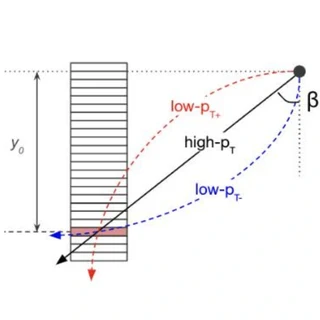
Highly granular pixel detectors allow for increasingly precise measurements of charged particle tracks. Next-generation detectors require that pixel sizes will be further reduced, leading to unprecedented data rates exceeding those foreseen at the High- Luminosity Large Hadron Collider. Signal processing that handles data incoming at a rate of O(40 MHz) and intelligently reduces the data within the pixelated region of the detector at rate will enhance physics performance at high luminosity and enable physics analyses that are not currently possible. Using the shape of charge clusters deposited in an array of small pixels, the physical properties of the traversing particle can be extracted with locally customized neural networks. In this first demonstration, we present a neural network that can be embedded into the on-sensor readout and filter out hits from low momentum tracks, reducing the detector’s data volume by 57.1%–75.7%. The network is designed and simulated as a custom readout integrated circuit with 28 nm CMOS technology and is expected to operate at less than 300 µW with an area of less than 0.2 mm2. The temporal development of charge clusters is investigated to demonstrate possible future performance gains, and there is also a discussion of future algorithmic and technological improvements that could enhance efficiency, data reduction, and power per area.
Type
Publication
Mach. Learn. Sci. Tech.
This open-access paper explores the use of deep learning for on-sensor data reduction in highly granular silicon pixel detectors intended for future high-luminosity colliders.
Key points
- Next-generation pixel detectors will produce data rates far exceeding those expected at the High-Luminosity LHC, necessitating intelligent filtering close to the sensor.
- The authors develop a neural network that uses the shape of charge clusters deposited in small pixel arrays to extract properties of the traversing charged particle and filter out hits from low-momentum tracks.
- In this first demonstration, the network reduces detector data volume by 57.1%–75.7%.
- The algorithm is designed and simulated as a custom readout integrated circuit in 28 nm CMOS technology, expected to operate at less than 300 μW with an area of less than 0.2 mm².
- The temporal development of charge clusters is also investigated as a path to further performance gains, along with discussion of future algorithmic and technological improvements.
Published 14 August 2024 in Machine Learning: Science and Technology.
Authors
Authors
Authors
Authors
Authors
Authors
Authors
Authors
Authors
Authors
Authors
Authors
Authors
Authors
Authors

Authors
University of Illinois at Urbana-Champaign
I am a professor at the University of Illinois. My research is highly interdisciplinary at the intersection of particle physics, AI/ML, and quantum, aiming to understand the universe at its fundamental level and to accelerate scientific discovery through innovation.
Authors
Authors
Authors
Authors
Authors
Authors