Evidential deep learning for uncertainty quantification and out-of-distribution detection in jet identification using deep neural networks
Jul 1, 2025·
 ,,,,·
1 min read
,,,,·
1 min read
Mark Neubauer
Ayush Khot
Xuwei Wang
Avik Roy
Vladimir Kindratenko
Abstract
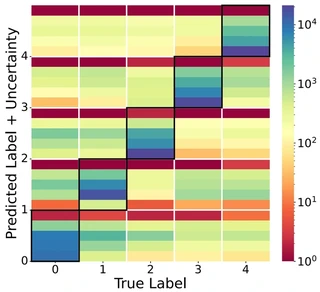
Current methods commonly used for uncertainty quantification (UQ) in deep learning (DL) models utilize Bayesian methods which are computationally expensive and time-consuming. In this paper, we provide a detailed study of UQ based on evidential DL (EDL) for deep neural network models designed to identify jets in high energy proton–proton collisions at the Large Hadron Collider and explore its utility in anomaly detection (AD). EDL is a DL approach that treats learning as an evidence acquisition process designed to provide confidence (or epistemic uncertainty) about test data. Using publicly available datasets for jet classification benchmarking, we explore hyperparameter optimizations for EDL applied to the challenge of UQ for jet identification. We also investigate how the uncertainty is distributed for each jet class, how this method can be implemented for the detection of anomalies, how the uncertainty compares with Bayesian ensemble methods, and how the uncertainty maps onto latent spaces for the models. Our studies uncover some pitfalls of EDL applied to AD and a more effective way to quantify uncertainty from EDL as compared with the foundational EDL setup. These studies illustrate a methodological approach to interpreting EDL in jet classification models, providing new insights on how EDL quantifies uncertainty and detects out-of-distribution data which may lead to improved EDL methods for DL models applied to classification tasks.
Type
Publication
Mach. Learn. Sci. Tech.
Add the full text or supplementary notes for the publication here using Markdown formatting.

Authors
University of Illinois at Urbana-Champaign
I am a professor at the University of Illinois. My research is highly interdisciplinary at the intersection of particle physics, AI/ML, and quantum, aiming to understand the universe at its fundamental level and to accelerate scientific discovery through innovation.
Authors
Authors
Authors
Authors