
$\Lambda_b$ Baryon Lifetime
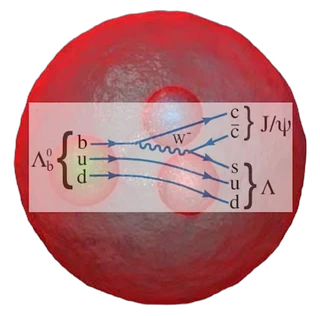
Measurement of the $\Lambda_b$ Lifetime in $\Lambda_b \to J/\psi \Lambda^0$ at the CDF experiment
Synopsis
The weak decay of quarks depends on fundamental parameters of the Standard Model, including elements of the Cabibbo-Kobayashi-Maskawa (CKM) matrix which describe mixing between quark families. Extraction of these parameters from weak decays is complicated since observed quarks are not free but are confined within color-singlet hadrons, as described by quantum chromodynamics (QCD). An essential tool used in this extraction is the heavy quark expansion (HQE) technique. In HQE, the total decay width of a heavy hadron is expressed as an expansion in inverse powers of the heavy quark mass $m_q$. Lifetime ratios of $b$-flavored hadrons are predicted to be unity through O(1/$m_b$), and O(1/$m_b^2$) corrections are small (< 2%). Detailed analysis of O(1/$m_b^3$) corrections to the lifetime ratio lead to an expected value of $\tau(\Lambda_b)/\tau(B^0) \simeq 0.94$. By 2006, this theoretical prediction has been in poor agreement with measurements for more than a decade, with the world average being $\tau(\Lambda_b)/\tau(B^0) = 0.804 \pm 0.049$.
On the CDF experiment, I led an analysis of $\tau(\Lambda_b)$ in the exclusive decay $\Lambda_b \to J/\Psi \Lambda^0$. A diagram of this decay channel is shown below:
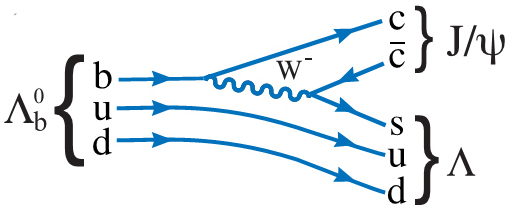
Decay channel $\Lambda_b \to J\psi \Lambda^0$ for this analysis
The muons from the J/Ψ decay are used to trigger the detector on Λ_b events and measure the decay vertex. The full reconstruction of the decay allows for measurement of the Λ_b momentum and therefore the cτ distribution, shown below for B^0 (left) and Λ_b (right):
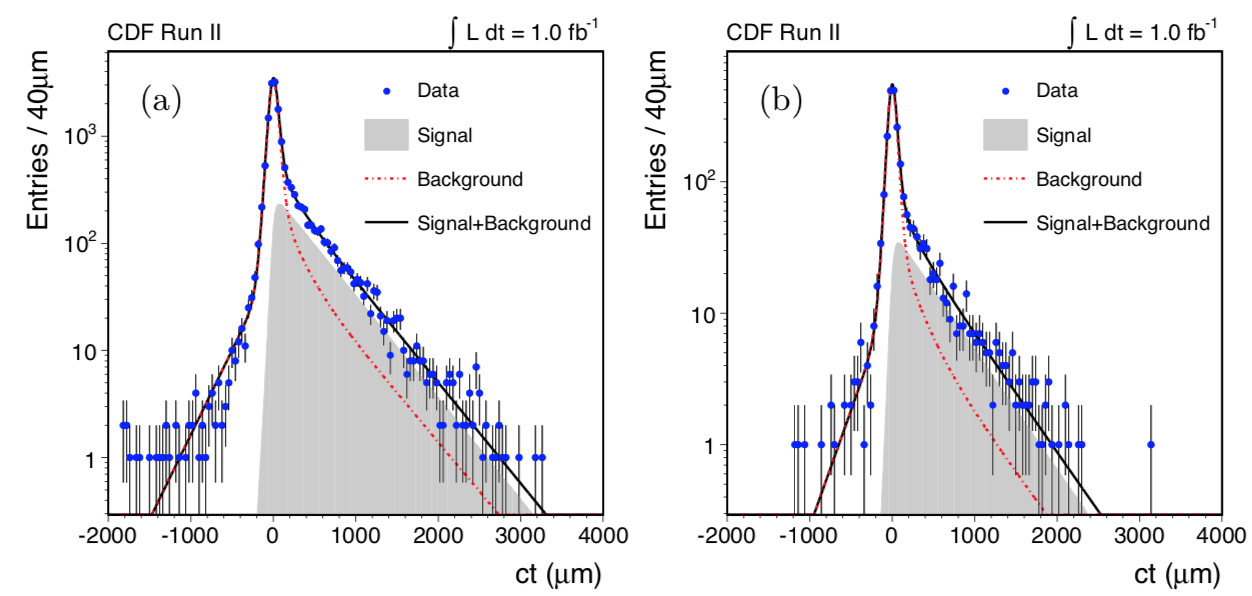
Figure: $c\tau$ distributions for $B^0$ (left) and $\Lambda_b$ (right)
We measured
$$\tau(\Lambda_b)/\tau(B^0) = 1.041 \pm 0.057 \text{ (stat. + syst.)}$$At the time of publication of this result PRL 98 (2007) 122001, this was the single most precise measurement of $\tau(\Lambda_b)$ and higher than the previous world average by 3.2σ. Our measurement resolved the “Λ_b Lifetime Puzzle” in favor of earlier theory calculations of $\tau(\Lambda_b)$.
Further Reading
H.-Y. Cheng, Phenomenological Study of Heavy Hadron Lifetimes, arXiv:1807.00916 (2018)
arXiv:1807.00916
