$W^{\pm} Z^{0}$ Production
Synopsis
The large $W$ and $Z$ boson production cross sections in $p\bar{p}$ collisions at the Fermilab Tevatron have been measured with high precision. The production of heavy vector boson pairs ($WW$, $WZ$, and $ZZ$) is far less common and can involve the triple gauge couplings (TGCs) between the bosons themselves via an intermediate virtual boson. Deviations of measured diboson production properties from Standard Model (SM) predictions could arise from new interactions or loop effects due to new particles at energy scales not directly accessible to a given experiment.
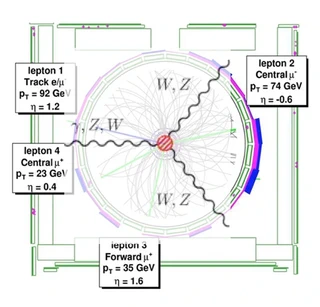
On the CDF experiment, I led an analysis that made the first observation of WZ production. This result was published in PRL 98, 161801 (2007). We used the full-leptonic decay of both bosons to observe $WZ$ production, which was also the first trilepton signal to be observed. Some kinematic distributions are shown below:
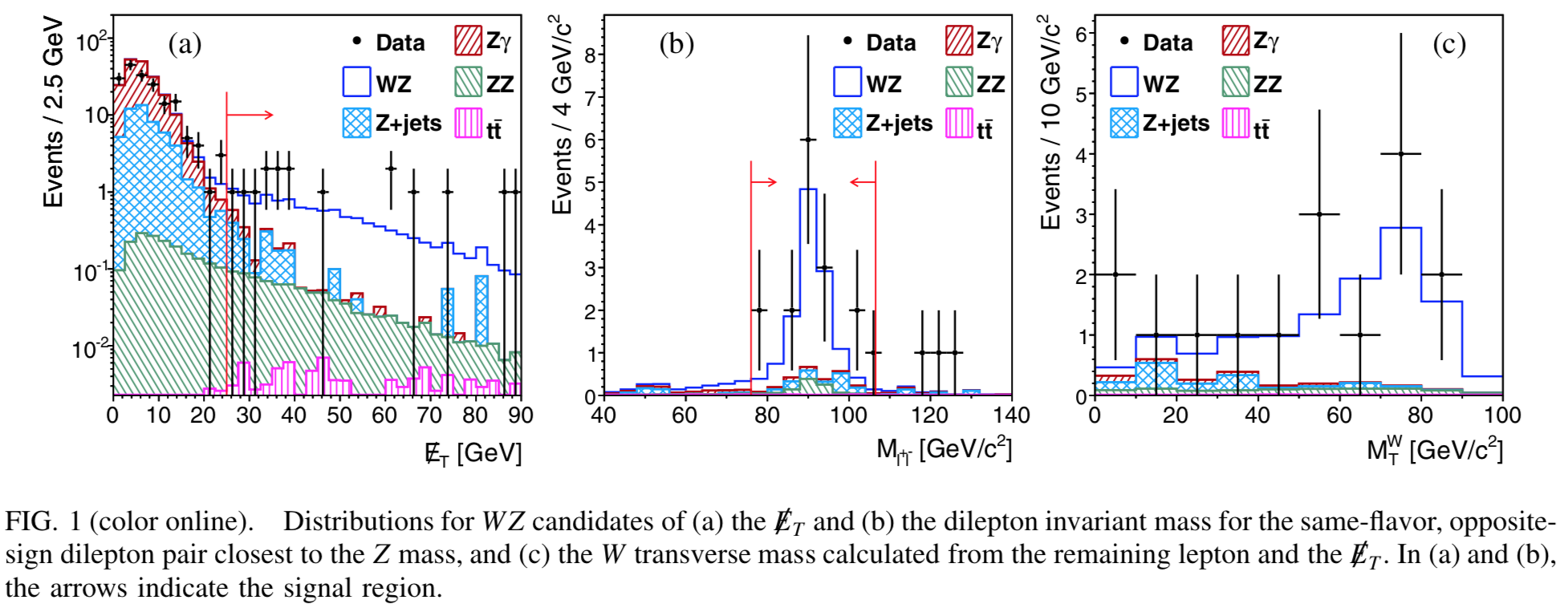
WZ candidate selection kinematics
The signal significance was 6σ. Having established a $WZ$ signal, we measured the production cross section to be
$$\sigma(p\bar{p} \to WZ) = 5.0^{+1.8}_{-1.4} \, (\text{stat.}) \pm 0.4 \, (\text{syst.}) \, \text{pb}$$Using similar analysis techniques on the CDF experiment, we also made the first measurement of ZZ production at a hadron collider PRL 100, 201801 (2008).
I have also authored two review articles on tests of electroweak physics Rev. Mod. Phys. 84, 1477 (2012) and diboson physics at colliders Ann. Rev. Nucl. Part. Sci. 61, 223 (2011).
Further Reading
- (2007). Observation of $WZ$ Production. Phys. Rev. Lett..
- (2008). First Measurement of $ZZ$ Production in $p\bar{p}$ Collisions at $\sqrt{s}$ = 1.96 TeV. Phys. Rev. Lett..
- (2011). Diboson production at colliders. Ann. Rev. Nucl. Part. Sci..
- (2012). Tests of the Standard Electroweak Model at the Energy Frontier. Rev. Mod. Phys..
